
Stay updated with our letter
Valuable perspectives on the latest trends and tips.



Blended theme-based product roadmaps for AI systems & enterprise software
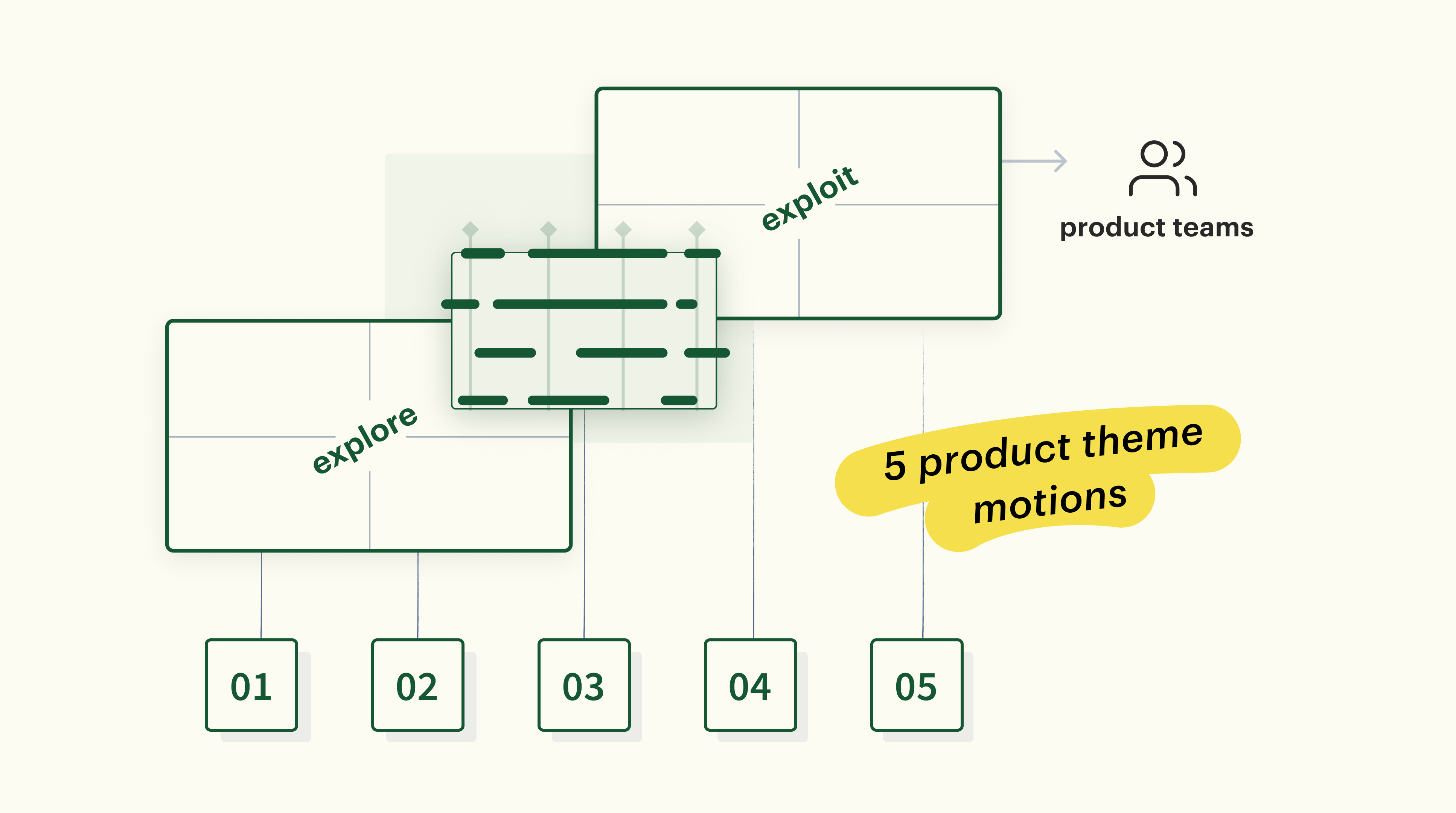


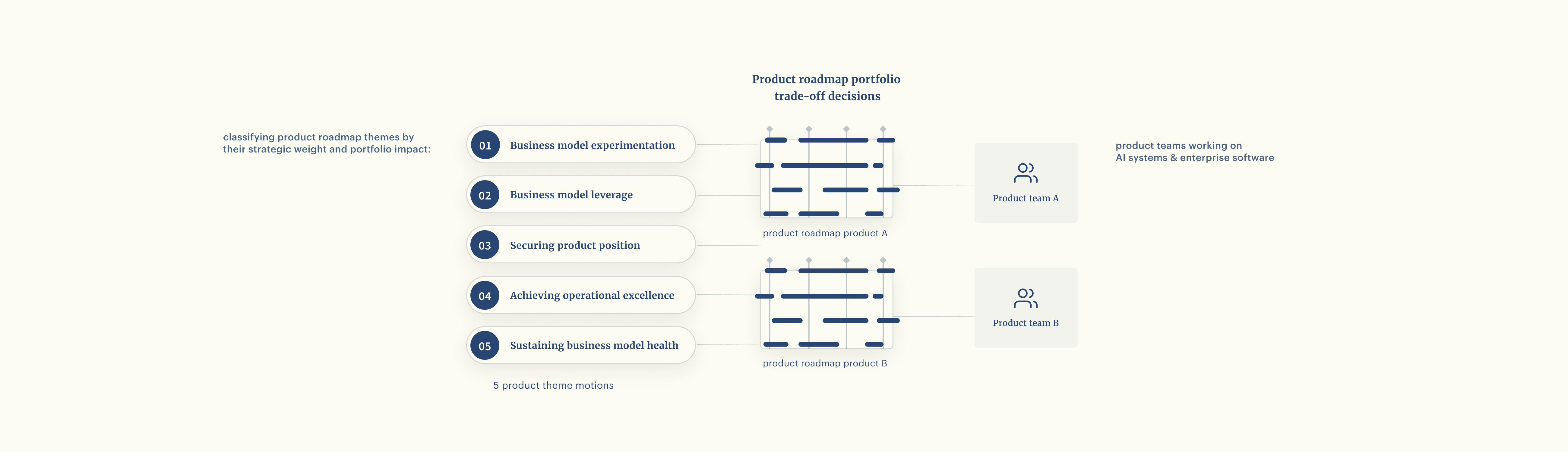
As product portfolios increasingly blend AI systems with conventional software, we can no longer afford to treat the product roadmaps as a simple list of product themes to be built and shipped via standard agile delivery. To operationalize portfolio governance in this new landscape, product leaders require a classification system that accounts for both strategic ambition and operational reality to build AI systems.
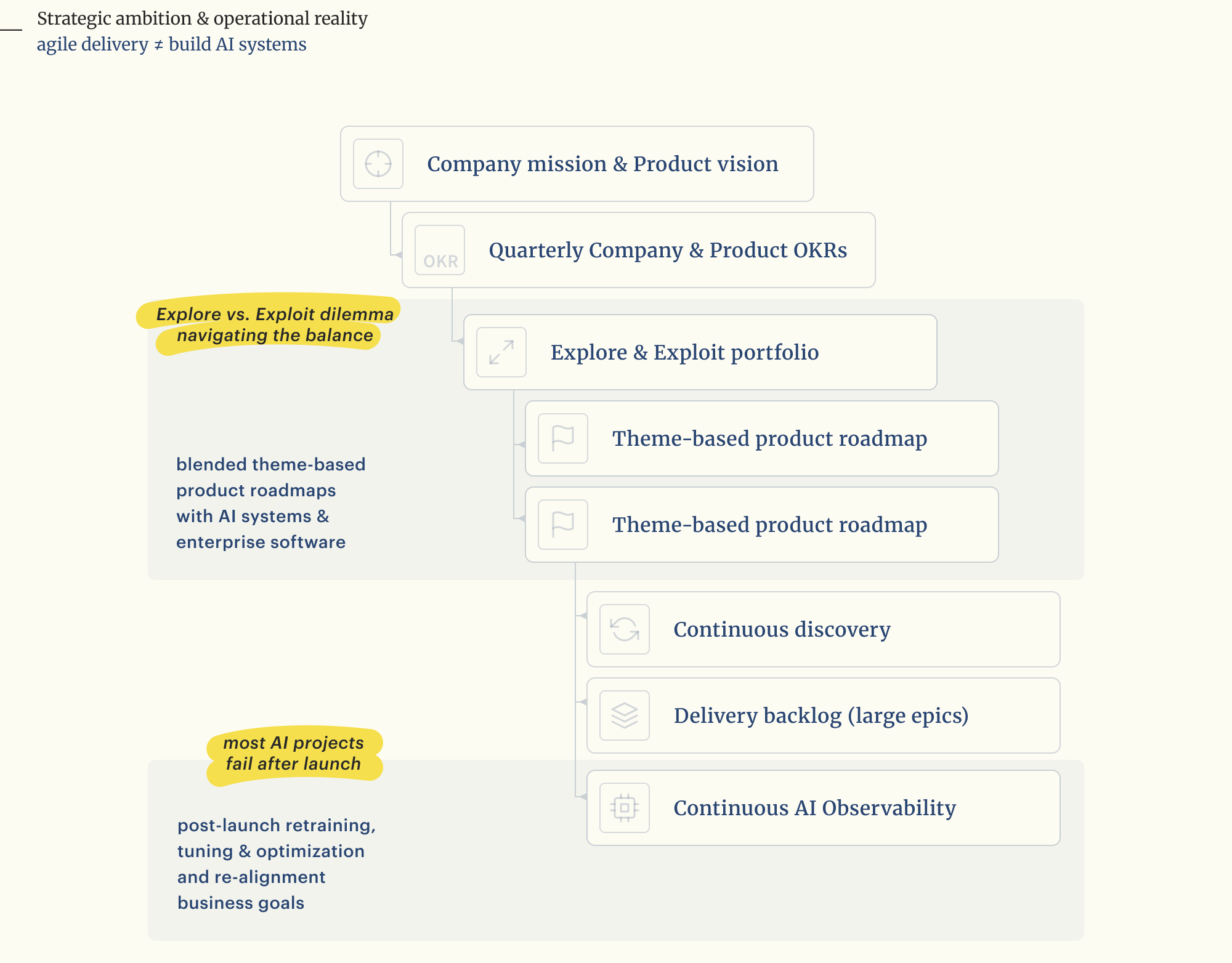
Classification system for theme-based product roadmaps
I've defined 5 key product theme motions for blended product roadmaps that provides a structured framework that ensures the probabilistic nature of AI model efficacy is not forced into the deterministic governance used for standard software delivery.
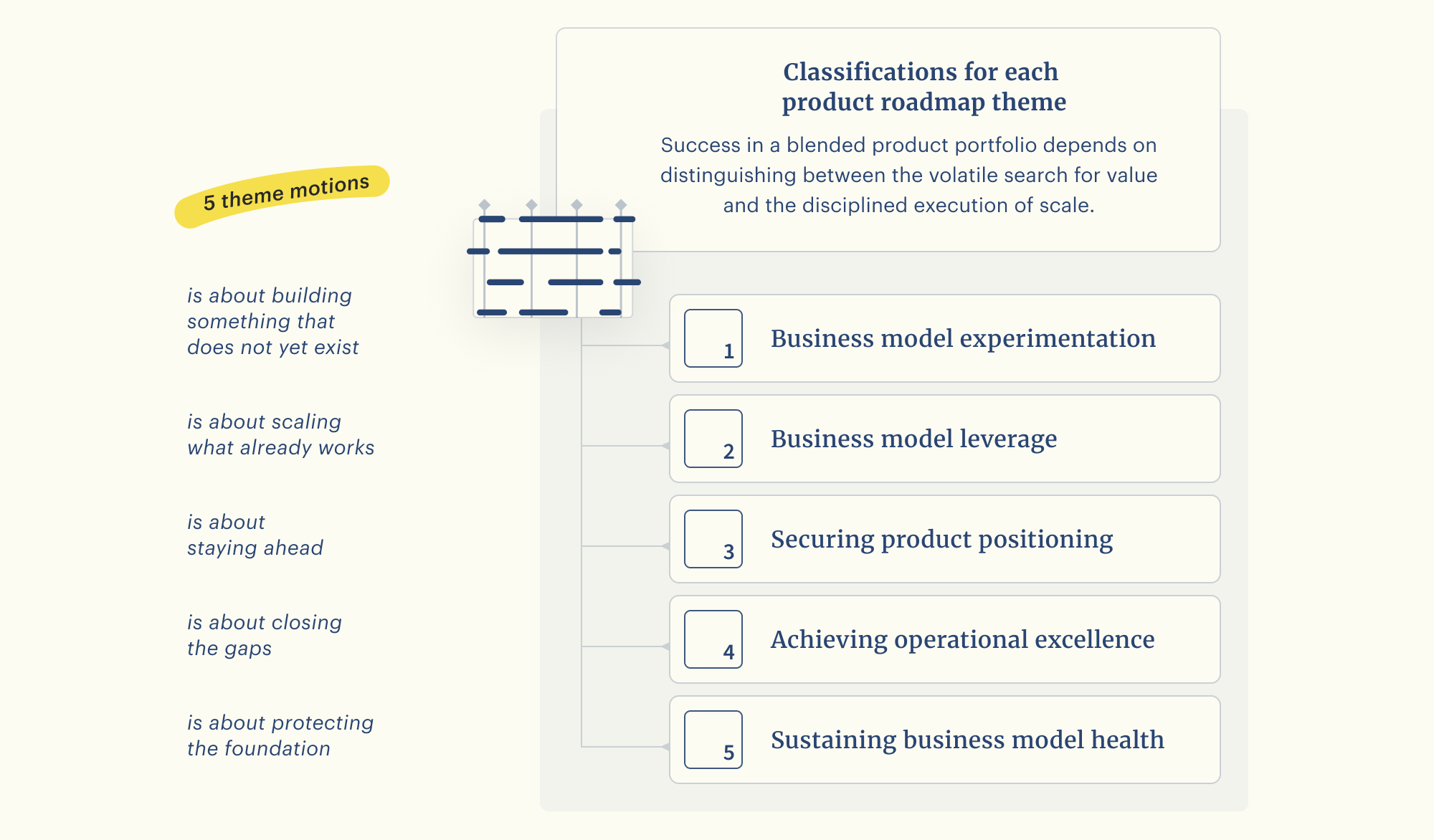
This framework spans from high-uncertainty experimentation to the stabilization of mature or declining business models. The 5 classifications for each product roadmap themes are:
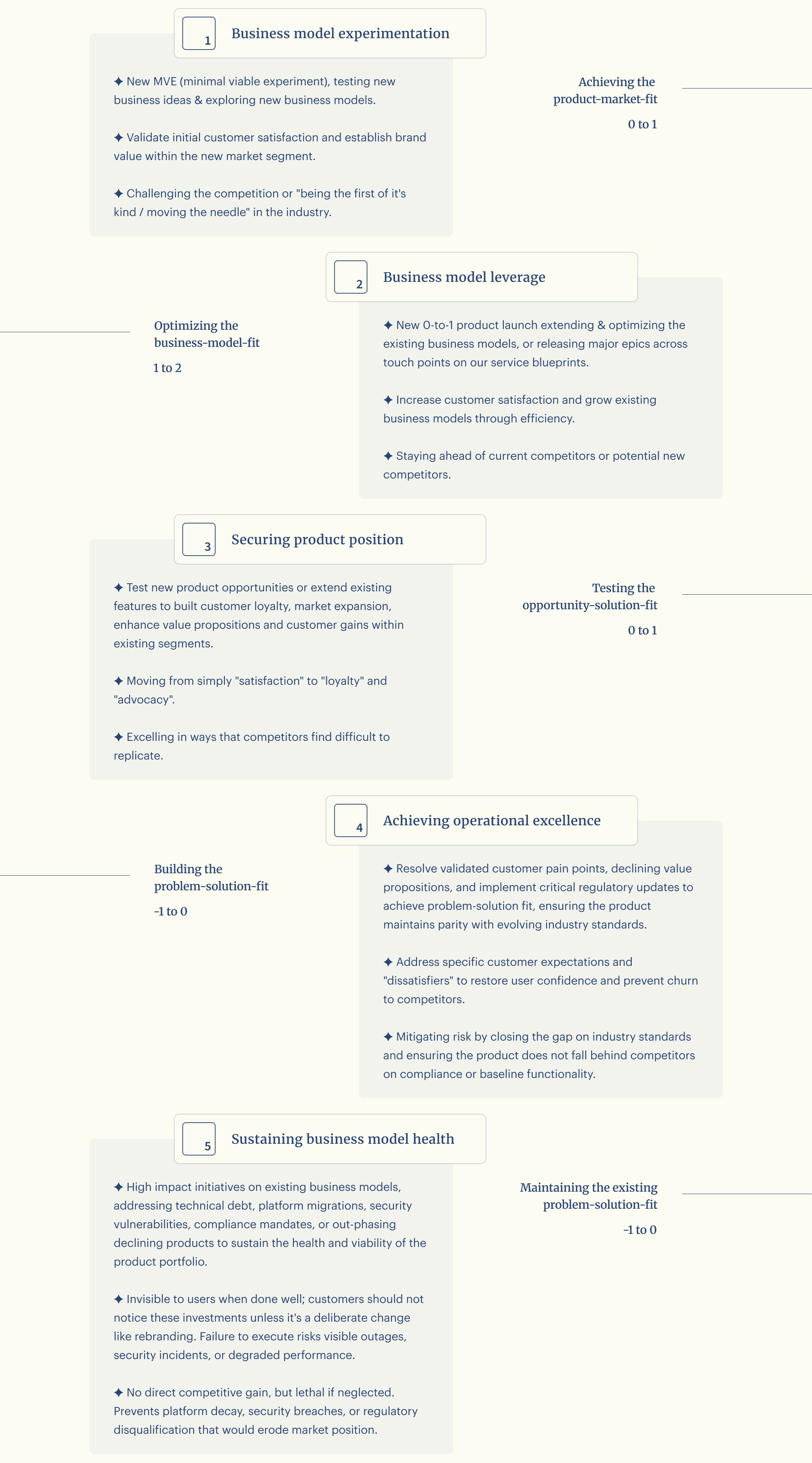
1 ✦ Business model experimentation
Early-stage business ideas experimentation or pivoting existing business models.
2 ✦ Business model leverage
Maximizing yield from captured market and incremental improvement of existing business models.
3 ✦ Securing product position
Strengthen competitive advantage to secure market relevance.
4 ✦ Achieving operational excellence
Zero-defect execution is the baseline for staying competitive.
5 ✦ Sustaining business model health
Prevent customer dissatisfaction and declining business.
High-level key characteristics roadmap initiatives
The following five motions categorize every roadmap initiative by its primary objective to ensure that the method of execution matches the nature of the risk:
Balancing extended learning cycles and declining value propositions
When applied consistently, the 5 product theme motions provide more than a categorization of work. They offer multiple roadmap portfolio views that reveal how product investment is distributed across:
✦ experimentation,
✦ scaling,
✦ competitive positioning,
✦ operational recovery,
✦ foundational maintenance, and
✦ operational demands of AI-driven initiatives.
These views enable product leaders to assess whether the current roadmap reflects intentional strategy or accumulated demand, especially where AI systems require extended learning cycles, model iteration, and ongoing operational stewardship
By defining product themes motions across planning horizons, such as quarterly OKRs or annual investment cycles, leaders gain clarity on the trade-offs they are making, the risks they are carrying, and the outcomes they are prioritizing. This makes portfolio balance explicit and creates a shared language for strategic reflection, adjustment, and governance.

Without explicit classification, product leaders lack the visibility required to navigate the Explore-Exploit continuum, including decisive actions on exploration investments, transitions to exploitation, strategic pivots, or timely exits.
The anatomy of product theme motions
True portfolio balance requires acknowledging that distinct roadmap themes demand distinct validation methods. Frameworks like RICE or MoSCoW often fail in this landscape because they apply a uniform logic to initiatives with incomparable risk profiles. An early stage AI experiment cannot be prioritized with the same criteria as technical debt remediation without distorting the portfolio strategy. You can access the full framework with the detailed breakdown of these characteristics via the link below (see end of this article).
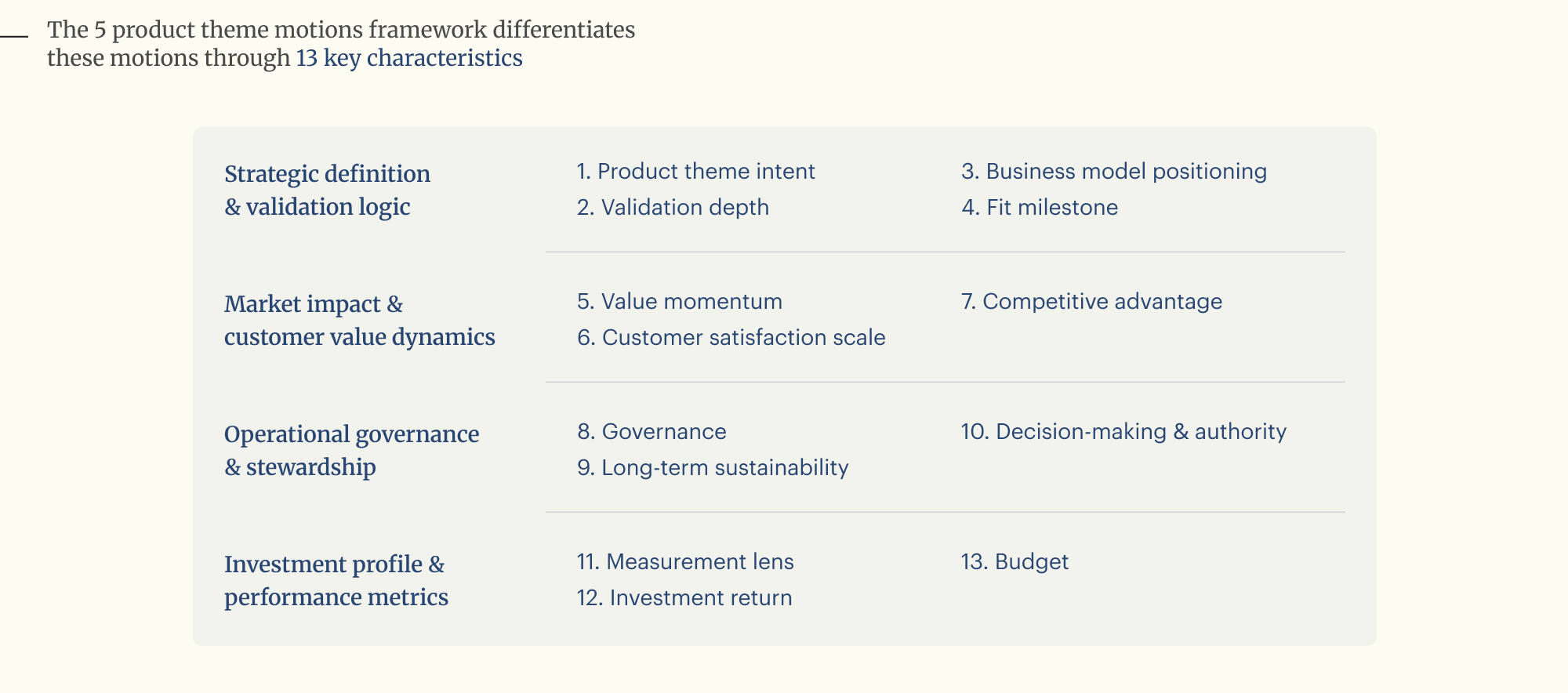
This framework differentiates these motions through 13 key characteristics. Each motion represents a distinct strategic posture, with corresponding criteria for:
✦ Strategic definition and validation logic
✦ Market impact and customer value dynamics
✦ Operational governance and stewardship
✦ Investment profile and performance metrics
Best practice prioritization method per roadmap initiatives
I will address the specific prioritization mechanics for the 5 product theme motions in a subsequent chapter. You can access the full framework with the detailed breakdown of these characteristics via the link below.